THE PLANCK SKY MODEL
Welcome to the PSM website!
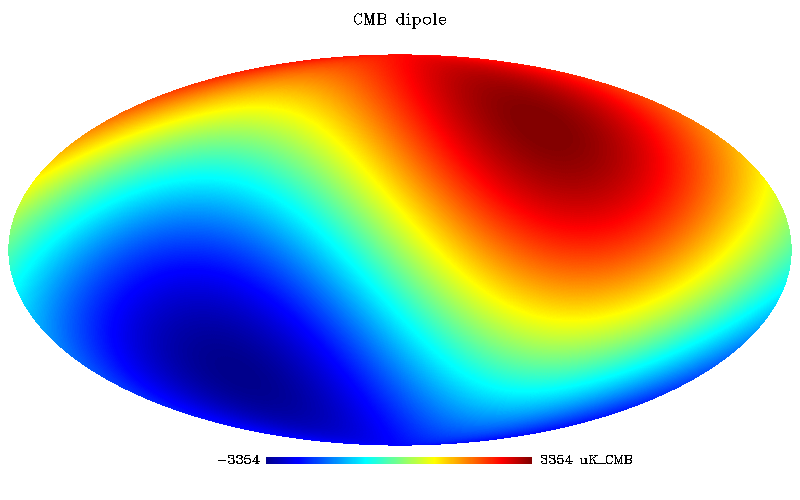
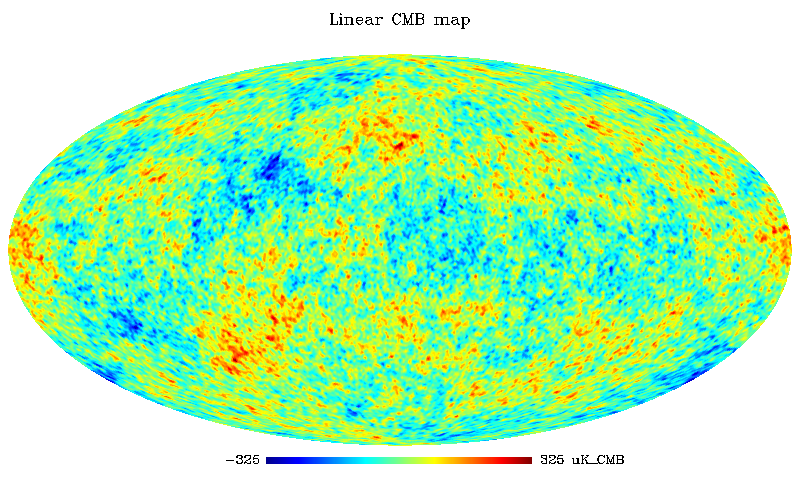
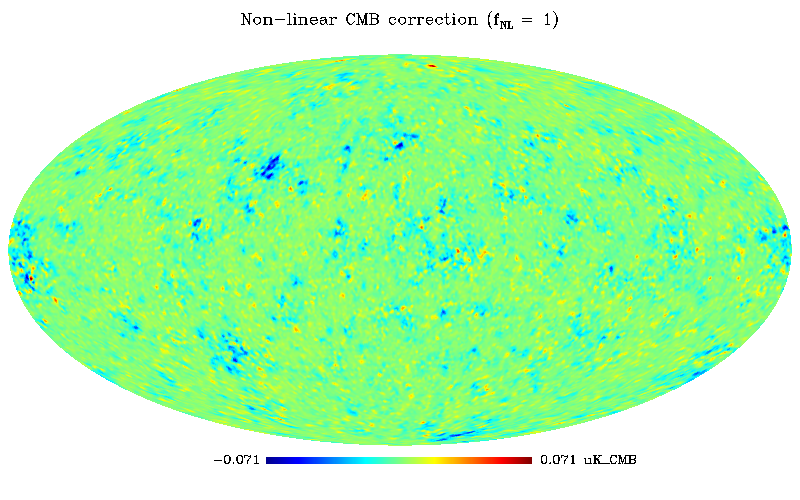
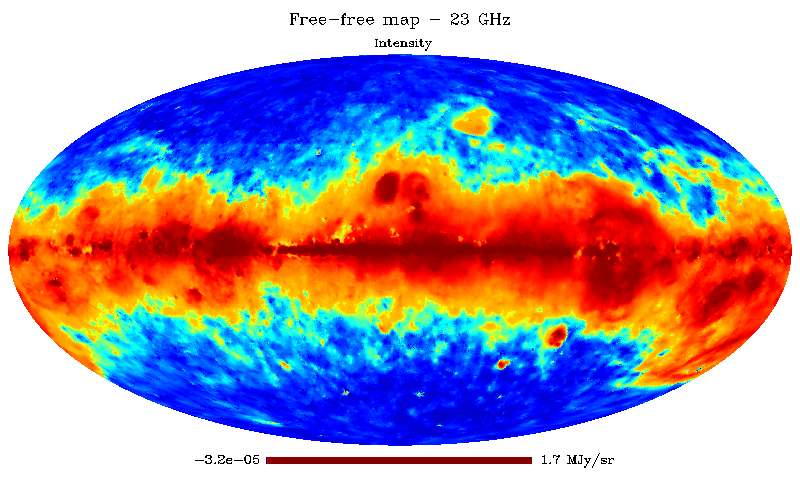
The project
The Planck Sky Model (PSM) is a global representation of the multi-component sky at frequencies ranging from 1 GHz to 1 THz, although it should in principle be usable from about 400 MHz to about 3 THz. It is designed to summarize in a synthetic way as much as possible of our present knowledge of the GHz sky. It comes with a complete and versatile set of programs and data, that can be used for the simulation or the prediction of sky emission in the frequency range of typical CMB experiments, and in particular of the Planck sky mission. It has originally been developed as part of the activities of Planck component separation Working Group (or "Working Group 2" - WG2), and of the ADAMIS team at APC.
The PSM software is developed with the objective to give users the opportunity to investigate the model in some depth: look at its parameters, visualise its predictions for all individual components in various formats, simulate sky emission compatible with a given parameter set, observe the modelled sky with a synthetic instrument. In particular, it makes possible the simulation of sky emission maps as could be plausibly observed by Planck or other CMB experiments, that can be used as inputs for the development and testing of data processing and analysis techniques.
The model has has been developed mostly by members of the Planck collaboration as a simulation tool for Planck activities. The first publicly released version (v1/7.8) is "pre-launch", with no Planck observation used to model sky emission. There is, hence, no guaranteee that simulated maps obtained with that version of the PSM will be fully compatible with Planck observations. Updating the model on the basis of Planck observations is one of the projects of the Planck collaboration (Project 1.11: Planck Sky Model ).
The software
The software is developed mostly in the IDL programming language. It uses the HEALPix sky-pixellisation package (with calls to C++ binaries), the astron and mpfit libraries, and uses CAMB and or CLASS as Boltzmann codes for computing the harmonic power spectrum of specific CMB models, as well as for computing the matter power spectrum at vairous redshifts if needed. The package comes as a collection of component-specific simulation codes put together by driver routines, automating fastidious tasks like parameter processing and component map coaddition.
The PSM is being continuously developed. Visit the web site regularly for releases of simulation products and of the software package.
The people
Global coordination and scientific responsibility
- Jacques Delabrouille and Gianfranco de Zotti.
Main developers and contributors
The following people have contributed to the PSM project so far:
- Mark Ashdown, Jonathan Aumont, Carlo Baccigalupi, Anthony Banday, Soumen Basak, Jean-Philippe Bernard, Marc Betoule, François Bouchet, François Boulanger Guillaume Castex, Dave Clements, Antonio Da Silva, Gianfranco De Zotti, Jacques Delabrouille, Clive Dickinson, Fabrice Dodu, Klaus Dolag, Franz Elsner, Hans-Krisitan Eriksen, Lauranne Fauvet, Gilles Faÿ, Tuhin Ghosh, Giovanna Giardino, Joaquin Gonzalez-Nuevo, Ata Karakci, Guilaine Lagache, Maude le Jeune, Samuel Leach, Julien Lesgourgues, Michele Liguori, Juan Macias, Marcella Massardi, Sabino Matarrese, Pasquale Mazzotta, Jean-Baptiste Melin, Marc-Antoine Miville-Deschênes, Ludovic Montier, Sylvain Mottet, Roberta Paladini, Bruce Partridge, Rocco Piffaretti, Gary Prézeau, Simon Prunet, Mathieu Remazeilles, Sara Ricciardi, Matthieu Roman, Bjorn Schaefer, Sybille Téchéné, Luigi Toffolatti, Ingunn Wehus, Niraj Welikala.
Acknowledgements
- The PSM project has benefitted from useful discussions with: Nabila Aghanim, Monique Arnaud, Karim Benabed, Rodney Davis, François-Xavier Désert, Hervé Dole, Frode Hansen, Lauro Moscardini, Francesca Perrotta, Jean-Loup Puget, Stephen Serjeant, David Sutton, Grazia Umana, Benjamin Wandelt.
- We thank the beta-testers and users of the PSM software who made useful suggestions and provided feedback about the code and its outputs, and in particular Charmaine Armitage, Julian Borrill, Alain Coulais, Jean-Marc Delouis, Jason Dick, Joanna Dunkley, Frédéric Guilloux, Thomas Jagemann, Hugo Jimenez, Martin Reinecke, Graça Rocha.
Collaborators welcome
- We are looking for a software engineer to help implementing and consolidating the PSM code.
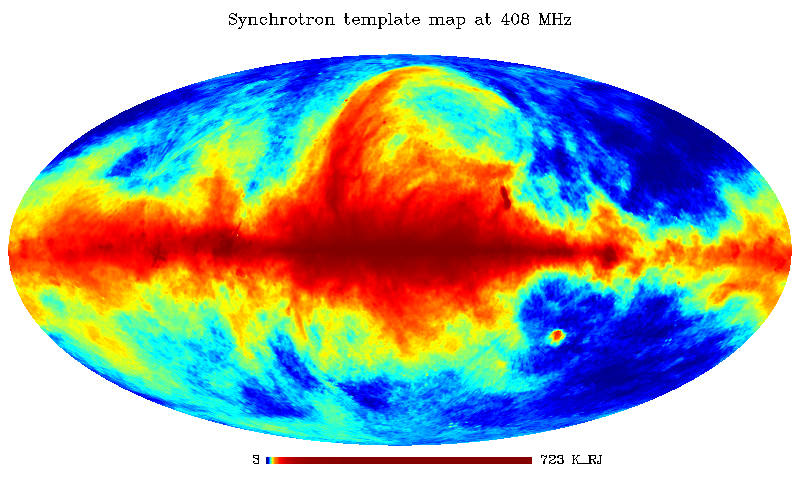
- The PSM is based on interpolation, extrapolation, fusion and interpretation of the best millimeter and sub-millimeter wave datasets available. Maps of diffuse observations, and/or catalogues of observed galactic and extragalactic sources are very useful for developing the model. The model of diffuse emission is mostly built using Planck, WMAP, IRAS, and DIRBE space mission data, complemented with the 408-MHz all sky survey synchrotron map of Haslam et al. (1982) and the CO (J=1-0) survey of Dame, Hartmann and Thaddeus (2001). Compact sources are modelled by extrapolating radio surveys (NVSS, SUMSS, GB6, PMN) and the IRAS catalogue of point sources. We are interested in any additional data that can be used to help improve the PSM.
- We wish to implement a model of zodiacal light emission in the PSM. Suggestions, inputs, software and suggestions welcome.
Contact Jacques Delabrouille is you are interested in any of the above.
Publications
Download the main paper describing the first version (Pre-Launch) of the PSM (published in A&A): aa20019-12_tap.pdf (10 MB)PSM releases
The following releases of the PSM are available for download. The status specifies whether the release is RESTRICTED to the Planck collaboration, or PUBLIC. Check the appropriate release page for additional information about each particular release: general comments, limitation and known bugs, specific recommendations. The PUBLIC releases are made available under the terms of the GNU General Public License as published by the Free Software Foundation (version 3 of the license, or any later version at the user option).
The current RECOMMENDED VERSION is v1.8.0 (or v1.7.8 for non Planck members).
| Date | Release page | Comments | Download user manual in pdf format  | Status |
|---|---|---|---|---|
| 09 Jan 2017 | v2.0.2 | Preliminary post-launch version. Many major updates, new models, makes use of Planck data from public releases 1 and 2. Compatible with FFP10 simulations. Not fully tested yet. | No user manual available yet... | RESTRICTED |
| 26 Jun 2014 | v1.9.0 | Version used to generate FFP8 simulations. | PSM_user_manual_v1_9_0.pdf | RESTRICTED |
| 27 Feb 2014 | v1.8.0 | Major update after FFP7 simulations (snapshot before new major update for FFP8). | PSM_user_manual_v1_8_0.pdf | RESTRICTED |
| 31 May 2013 | v1.7.8 | This is the public release that goes with the PSM Pre-Launch publication. | PSM_user_manual_v1_7_8.pdf | PUBLIC |
| 24 September 2012 | v1.7.7 | This is a minor update of v1.7.6. The documentation has been expanded, and some details have been fixed in various places (nothing critical). | PSM_user_manual_v1_7_7.pdf | RESTRICTED |
| 18 September 2012 | v1.7.6 | This is a major update of the PSM software. See the release page for details. | PSM_user_manual_v1_7_6.pdf | RESTRICTED |
| 21 March 2012 | v1.7.5 | This is a minor update of v1.7.4. A new feature is a model of galactic magnetic field according to Fauvet et al. 2011, that can be used to generate templates of polarised galactic emission. Available instrument models based on Planck RIMOs have been temporarily modified, but probably need a complete revision. | PSM_user_manual_v1_7_5.pdf | RESTRICTED |
| 16 March 2012 | v1.7.4 | Version essentially fixing bugs introduced in version 1.7.3: Corrected dust polarisation amplitude, fixed bugs for Gaussian CMB (which has been improved and tested more thoroughly). Also expanded the documentation, implemented relativistic SZ effect included for some SZ models, and updated the radio-frequency part of ultra-compact HII regions. | PSM_user_manual_v1_7_4.pdf | RESTRICTED |
| 04 December 2011 | v1.7.3 | Version updated and released specifically for preparing Planck FFP4 simulations. Not recommended (tested only for very limited configurations). | PSM_user_manual_v1_7_3.pdf | RESTRICTED |
| 28 September 2011 | v1.7.2 | This version is a minor update of v1.7.1. | PSM_user_manual_v1_7_2.pdf | RESTRICTED |
| 13 September 2011 | v1.7.1 | This version updates some templates for the Galaxy, corrects high multipole galactic emission and fixes a few minor bugs in v1.7.0-beta. | PSM_user_manual_v1_7_1.pdf | RESTRICTED |
| 25 August 2011 | v1.7.0-beta | This version is a major revision of the PSM, released internally to the Planck collaboration for beta-testing. | PSM_user_manual_v1_7_0-beta.pdf | RESTRICTED |